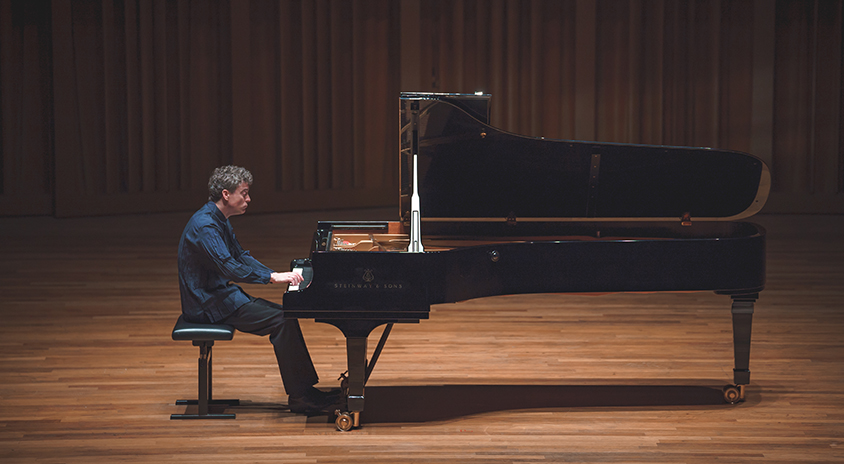
Lewis says he hears a similar lightness of touch in Poulenc’s Improvisations pour le piano.
‘The way he layers voices I think has a clear connection to Mozart – it’s not this French, impressionistic way of producing colour. There is discretion in the way he writes – you have to be very clear with your voicing and colours in the way you are with Mozart. But it also has that French flavour, which connects with Debussy from the other side.’
An evening of music by Mozart, Poulenc and Debussy ‘may not seem obvious on paper’, Lewis says, but he encourages the listener to lean in closer.
‘You have the very lyrical C major sonata at the start, and the hugely dramatic C minor sonata at the end,’ he says. ‘I like the idea of Mozart having been affected by the journey, and you have this drama, this tension in the music that you didn’t have at the opening of the program.’
Growing up in Liverpool, in the UK, Lewis did not come from a musical family but his talent was identified when he was young. His first instrument was the cello, and the local library fed his imagination as he borrowed LP records of classical music. He’s described the ‘rush’ he felt at hearing unfamiliar pieces of music for the first time.
He attended Chetham’s School of Music in Manchester and later the Guildhall School of Music and Drama. Brendel became a mentor – and his most important teacher – in the 1990s.
Last January, Lewis appeared in an all-star tribute concert on what would have been Alfred Brendel’s 95th birthday. Lewis played Beethoven’s third piano concerto, with Simon Rattle conducting. As The Observer put it, Lewis’s ‘mix of freedom, sensitivity and discipline honoured the Brendel tradition’.
Was there a particular lesson that Lewis learned from the many years he spent with Brendel?
‘The most important thing was the way he broadened my perspective,’ Lewis says. ‘He opened doors to different ways of thinking and understanding music.’
You can hear Paul Lewis bring Mozart+ to Adelaide, Brisbane, Canberra, Melbourne, Newcastle, Perth and Sydney from 4–15 October.