

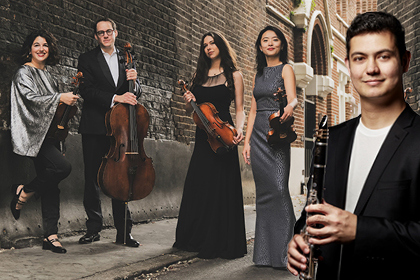
What was your experience of the Doric String Quartet before you joined in 2024?
The Dorics have always been part of my musical world. I listened to them live for the first time at their teaching course in Mull. Ying wasn’t there, unfortunately, but I heard them playing individually in different groups and loved everything they were about. A year later, I played quintets with them at a festival in Norway and heard their Beethoven and Schumann as well. It was exactly how I would have wanted to play, and I realised it was my dream to join them. During Covid, I played string quartets with friends, and we used the Dorics’ Haydn recordings for inspiration, among many others of theirs. So it feels very much like I’ve come full circle.
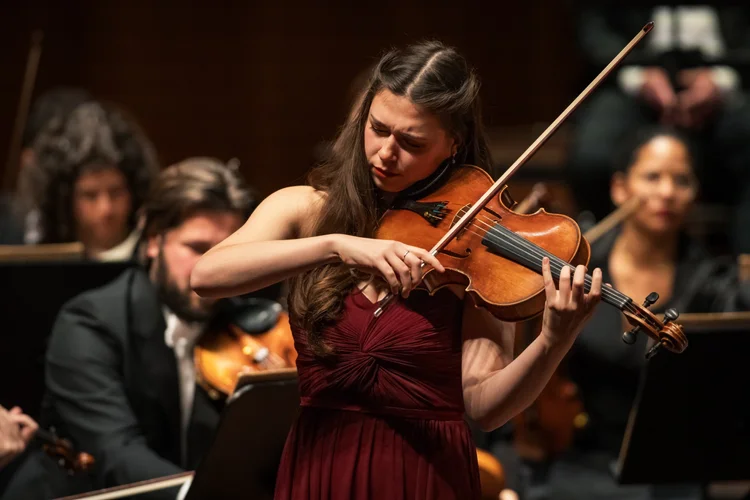
Emma Wernig performing with Philharmonie Reutlinge at the Stadthalle Reutlingen (2024). Credit RMG-Record Music Group.
The Dorics have always been part of my musical world — it was my dream to join them.
Has the quartet’s sound changed since you and Maia became part of the group?
The sound of any quartet is made up of the people who are in it, and that evolves naturally, but the quartet's principles of music making have remained the same. We all come with similar artistic and aesthetic attitudes. We’re all honest musicians with a shared dream of what we want to achieve.
What is the quartet’s rehearsal process?
It’s mostly a lot of slow playing, listening closely to what the piece has to say without yet putting what we think it needs on top. We observe how the music changes and evolves, and try to allow that to happen as organically as possible. When you spend a lot of time with a work, it becomes increasingly difficult to remain present in that process because you already know what’s coming. You want the understanding and quality of playing, but also to feel surprised by every moment, as if it is the first time you’re hearing it. Whether it’s the first rehearsal or the twentieth time we’re playing a piece, the way we rehearse is similar: stripping back the music, trying to simplify our thoughts, and as simple as it sounds, just listening.

Emma Wernig (2022). Credit Alexander Edelmann.
What was the experience of recording Beethoven quartets, in completion of the set?
Recording a Beethoven cycle is monumental. It’s been a huge learning opportunity and a massive privilege. This is the greatest music ever written and in a recording you have the chance to make it sound how you’ve always dreamed. It’s difficult to pick a version to be immortalised, though, especially as we are such a spontaneous group. Some people think you need to have lived with the pieces as a group for 20 years to be able to decide authoritatively what ‘the’ version is, but it will always be the version recorded that day and that moment. We are lucky that the quartet has always worked with Jonathan Cooper, an amazing recording engineer at Chandos, who understands what the group is about and has helped guide the process with so much trust and positivity.
How do you make sure rehearsals are productive?
There’s a general rehearsal rule never to say no. Even when there are different views, we always try to see if an idea will work before deciding against it. We cultivate a general attitude and culture of respect, which is important. Many quartets have one person who speaks more than the others, or someone who runs the rehearsal, but in this quartet, we’re somewhat uniquely all quite equal in our contributions. It’s a highly collaborative process. We love getting into the details necessary to make a refined performance, and often the most helpful thing when we are deep in discussion, is when one of us reminds us, ‘Let’s just play’. That ends up being the most helpful thing – listening to what we’re actually doing. It’s a very wholesome, passionate process.
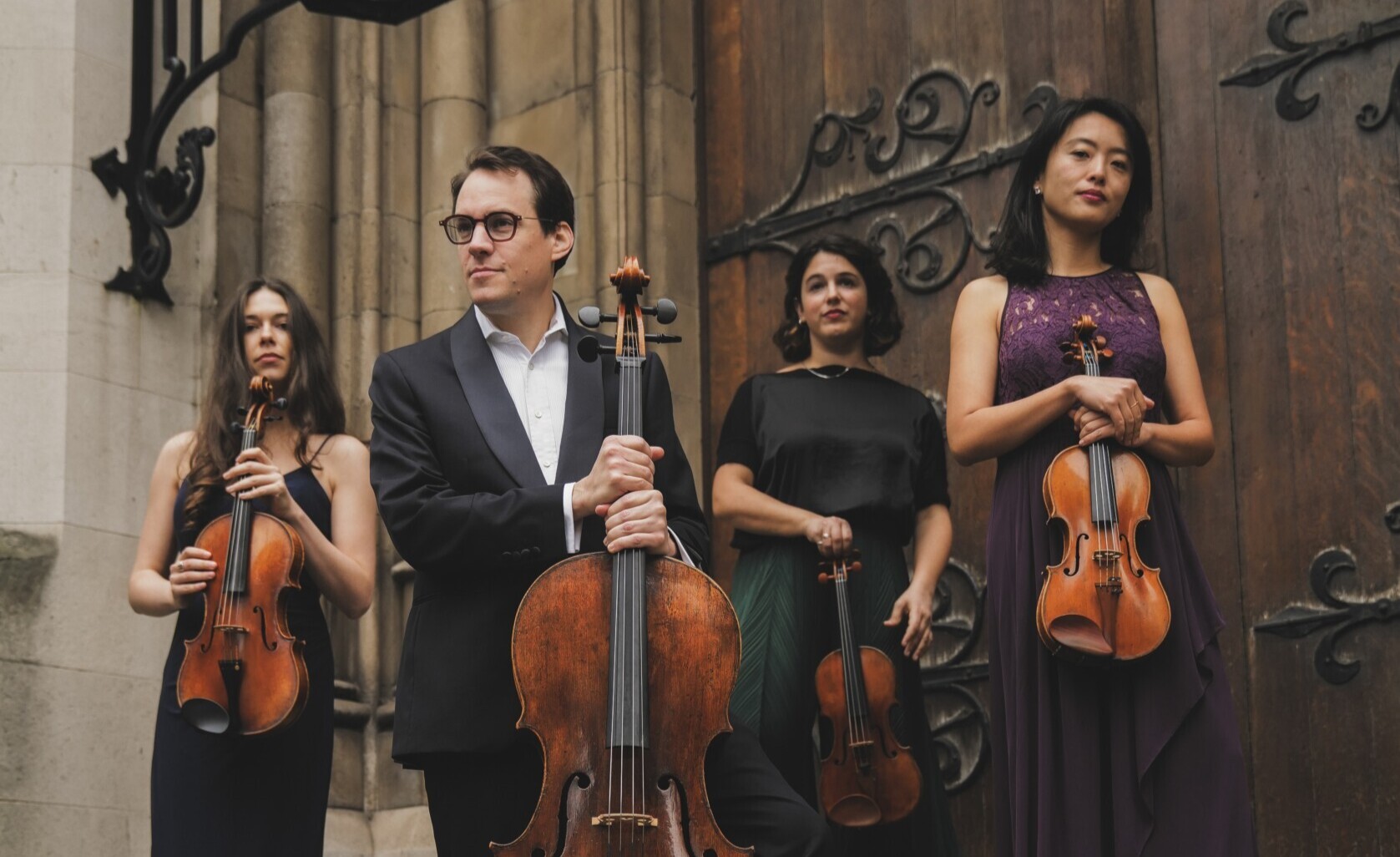
The Doric String Quartet (2026). Credit Kirk Truman.
How does playing the same repertoire across a tour affect your interpretations?
Performances are also part of the rehearsal process, and on tour we are lucky to get to play pieces many times. This allows us to be spontaneous, letting the music affect us in different ways and moving in one direction or another. It’s a small improvement here or little evolution of a phrase there that keeps you moving forward and eternally interested. The way we play is always different, based on the day, the rehearsal, the hall, the city, the space and the atmosphere of that moment. These all change how you interpret musical details. That’s wonderful, but it can also be frustrating, because one corner that may have been fantastic in one atmosphere is changed the next night. You have to be comfortable with impermanence. One of the great joys of quartet playing is that you have the opportunity to be spontaneous in a unified way.
When you coach young string quartets what advice do you usually offer them?
It’s the same thing we say to ourselves, which is, ‘Are you actively listening to what you’re doing?’ We’re all attached to what we think we’re doing or want to be doing, living in that future version of ourselves, rather than being aware of what’s happening in the present moment and committing to that fully. You see a young group going for it passionately, which is wonderful, but they’re in four different places, instead of channelling that into the present moment together and letting it evolve organically.
It’s about removing ego and widening your perspective – and not from a place of fear. Everyone must listen genuinely and want to play together, or it won’t happen. It’s the same if you’re having a conversation or an argument. If everyone is saying ‘I have this idea and I’m passionate about it,’ and there’s no desire to find commonality, there won’t be any understanding.
There’s a lot of pressure on young groups to be interesting or different while being impossibly clean. You hear many good groups who make specific decisions and focus on delivering them precisely and exactly together. It’s so controlled that they can lose the natural quality that keeps the music alive with possibility, even at the risk of imperfection.
Whether it’s the first rehearsal or the twentieth time we’re playing a piece, the way we rehearse is similar: stripping back the music, trying to simplify our thoughts, and as simple as it sounds, just listening.
What does being in a string quartet teach you?
String quartet playing is the ultimate teamwork. It teaches you about compassion, problem-solving, conversation, listening, mindfulness – the list goes on! In terms of playing, it demands a technique that is multifaceted and specific. It’s a three-dimensional experience: you’re aware of yourself, but everything you do is in service of the music that exists outside yourself. You do something specific with your sound or articulation so that someone else is able to do something specific with their sound, to be able to support the third person, so that you can all support the fourth person to make a phrase happen the way you’d all like.
You have to be aware of all the different levels at once. I often have to be several people at once, as the viola line is often a second cello or third violin. Everyone’s ears have to be everywhere. The inner voices, especially, have to juggle about seven roles at any given moment and remain present but supportive. It’s a constant balancing act. There are about a million hidden jobs that no one ever sees, but your colleagues know you’re doing them, which is a lovely thing.
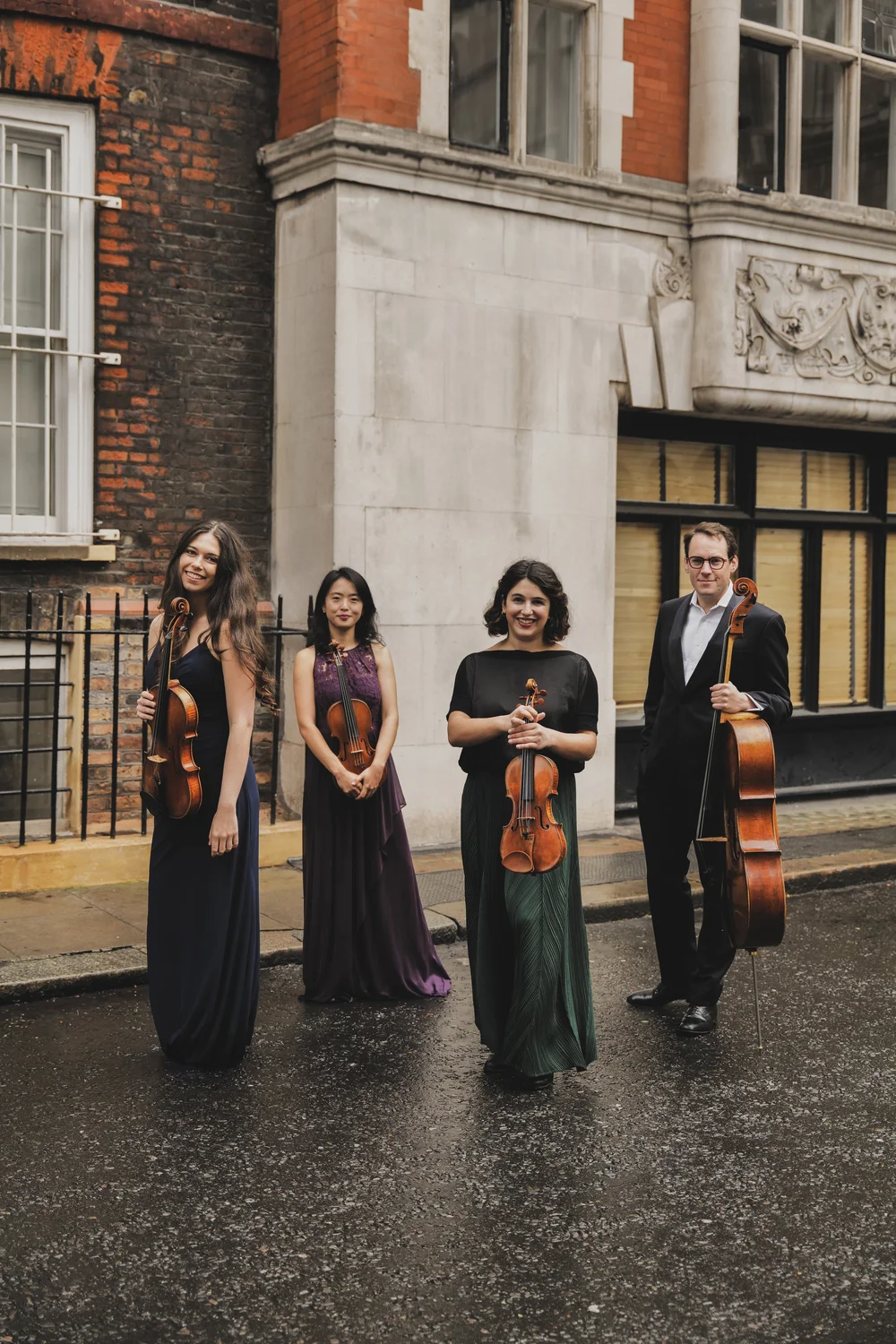
The Doric String Quartet (2026). Credit Kirk Truman.
Pictured in the banner image is Emma Wernig (2016). Credit the Emma Wernig official website.
This interview appears with thanks to Ariane Todes and Maestro Arts.
The Doric String Quartet & Lloyd Van't Hoff tour from 15-28 June, appearing in Adelaide, Brisbane, Canberra, Melbourne, Newcastle, Perth and Sydney.